|
Ring 2.
Our next hurdle -- the stone... Our hunt began again -- what stone belongs in that setting? The Orange Blossom design has a look of antiquity to it -- while it was the early 70s when Vicky Jo saw it in that jewelry store in Iowa, who knows how long that style had been around, or what it may have been copied from. We wanted a stone that would complement the setting's heirloom style appropriately. As it happens, Vicky Jo makes a lousy gold-digger. (If you know her well, you know just how true this statement is.) She's simply not comfortable sporting a huge rock on her hand. While she admires it greatly, she's allergic to the notion of wearing that $40,000 Van Craeynest ring. Heck -- a mere 1-carat diamond gives her palpitations just fretting over the responsibility! She didn't have her heart set on a diamond by any means. So we explored a zillion other possibilities -- from opals to sapphires to Tanzanite -- a pretty stone VJ particularly loved. You have no idea what you're getting into
when you first dip your big toe in the shimmering pool of precious and
semi-precious gemstones. Vicky Jo liked blue stones, purple stones, and pink stones -- or even white stones that could pass for diamonds.
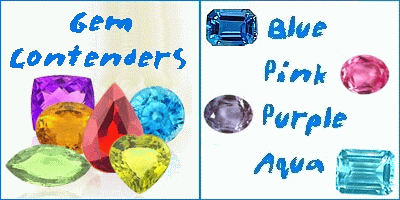
Here are some interesting rocks that caught our eye:
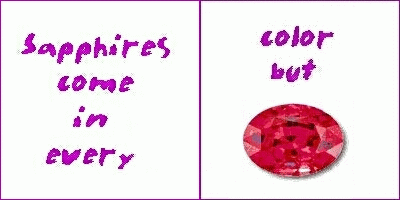
Did someone mention sapphires?
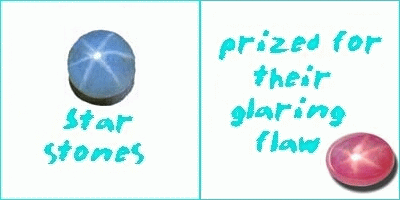
Here are some very special sapphires.
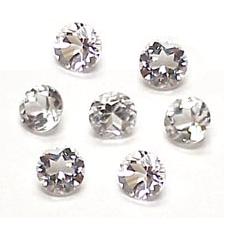
These are the diamond wannabes that might pass for a diamond.
Here are some wild "carved" stones which spur the imagination.
Which brings us to the big "D."
Diamonds possess some traits other gems
can't boast -- including the fact that the stone is highly prized; a diamond's sparkly neutral
colorlessness clashes with no outfit
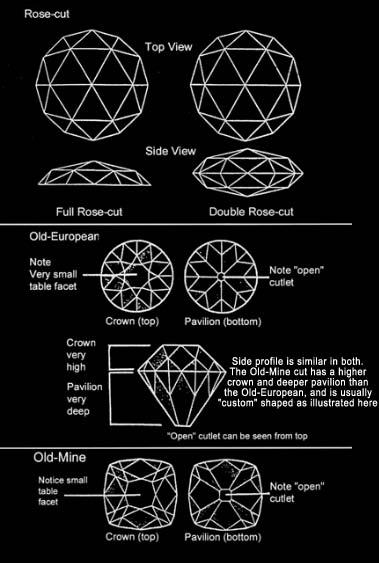
We were attracted to antique diamond cuts, just as Peter initially suggested to us, as it suited the ring style best. They also had an air of history and mystery. Through our diamondology education, we read all we could find about the old cuts -- the rare Mazarin and Peruzzi; the rose cut, old European cut, and miner's cut.
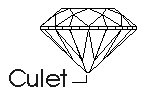
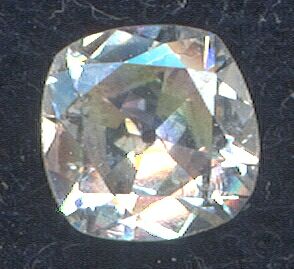
This latter is sometimes called transitional cut, early round, old miner's cut, old miner's cut brilliant, miner cut, or mine cut (whew!). Circa 1890-1930, they are considered antiques, and workmanship is key since these cuts were all cut and polished by hand, not machine. Miner's cut gems display a shallow, "cushion" cut, with a small table, high crown, deep pavilion, and squarish girdle. They look sort of "lumpy." Old miners were cut before 1900 with the bottom tip (called the culet) cut off flat, because they believed this would allow even more light into the diamond.
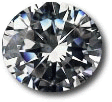
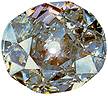
That big dot in the center marks this as an old miner's cut stone These old cuts began to disappear around the turn of the century once the "ideal" cut was introduced, and more sophisticated diamond-cutting equipment was invented that could cut a diamond perfectly round but still featuring the same 58 facets.
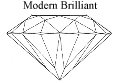
What soon became apparent to us is how there appears to be two prevailing "camps" with opposing attitudes toward these particular diamonds. The first camp emphasizes the inferiority of their shape, focusing on their "fat" cut -- which is intended to maximize the stone's size rather than its appearance -- whereas modern cuts are laser sliced to exact standards designed to maximize "fire." The large culet facet is considered undesirable because it may be visible to the naked eye when viewed through the table (as in the above example). This camp claims the old cuts are too heavy, lacking symmetry and good proportions, and hold no appeal for the buying public. They consider the modern brilliant "ideal cut" to be infinitely superior, and some even recommend having old stones re-cut in order to increase their value. Their motto is "more flash for the cash."
We decided we wanted to be in this latter camp. Vicky Jo wanted to give John Anderson the gem sale, and not just because of the favorable Canadian exchange rate, either. She felt she owed it to him, with all he'd done for her with the Orange Blossom search. So we hit John with the question: "Can you obtain a miner's cut diamond for us?" Sadly, he didn't seem keen on the notion, and suggested a modern "ideal" cut would be better. John indicated that miner's cut stones are considered low quality, undesirable gems, positioning himself squarely in the camp that shuns the older cuts of diamond. He didn't
know who he was talking to. We poked around in a few jewelry stores but always came up empty. Half the time, the salespeople didn't have a clue what we were looking for, and knew nothing about antique stones. Robin's business took us to London. While we were
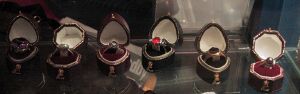
there, Vicky Jo kept an eye peeled for those charming ring boxes she'd liked, but
couldn't find any. On Thursday afternoon, Robin phoned up 23rd Street
Jewelers in Santa Monica. They were surprised to learn he was calling from
London.
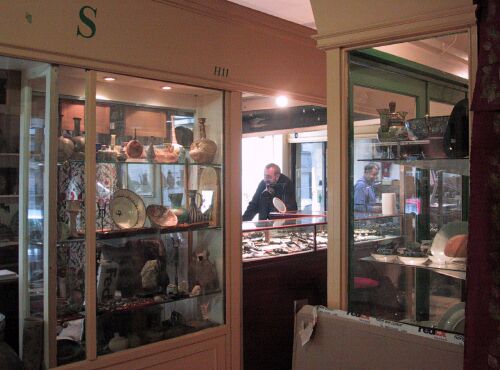
When Robin finished work at lunchtime on Friday, we strolled on up to Davies Street to scope it out. The place is like a "farmer's market" or "swap meet" for antiques and jewelry -- hundreds of tiny stalls housed in a large "store," all selling various unusual items.
As we entered the building, Vicky Jo indicated the first jewelry stall her eye fell on and asked Robin to check and see if they sold the ring boxes. As an afterthought, "While you're at it, see if he has any miner's cut diamonds."
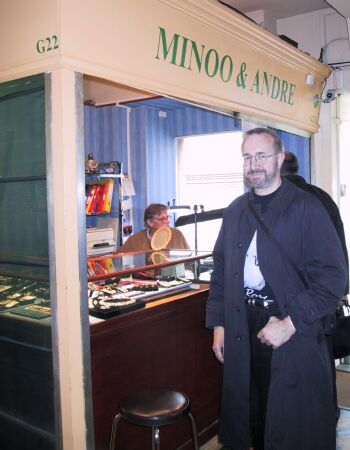
Naturally, Robin asked. Imagine our surprise when the attendant turned to a small drawer, pulled out a folded white tissue envelope, and poured forth no less than seven loose miner's cut diamonds for us to peruse! As it turns out,
miner's cut diamonds were this vendor's specialty! Attempting to conceal our excitement with feigned indifference, we picked over the stones. Robin employed his newfound "diamondology" knowledge, and inspected them for shape and visible inclusions. Vicky Jo had her eye peeled for color. We both settled independently on a particular rock that "spoke" to us. Lucky for us -- it happened to be the same stone! We were drawn to a 42 point, 100 year old stone extracted from a vintage piece of jewelry. The vendor named his price, and we retired to discuss it over lunch. And whatta discussion ensued! Picture
this: we're 6,000 miles from home; we're due to fly out first thing
tomorrow morning; we're facing a crucial decision; evening is drawing
near and the place will be closing soon. Man! We were sweating bullets, asking all manner of questions:
Could we find an equivalent stone in the U.S.? Was this a good price?
Was the guy trying to rip us off? Were there better deals to be found in
a nearby stall? (Certainly whatever advantage we'd gained buying the
setting in Canada would be lost against Britain's exchange rate. Rapidly gulping his lunch, Robin decided he'd do more research and went off to check out other vendors while Vicky Jo finished eating (and engaged in nervous nail-biting and unfettered hand wringing). Robin visited approximately a dozen other stalls and found only two more miner's cut diamonds. Each was already mounted into a ring and could not be sold separately. Robin established the price of these old gems, and then felt prepared to approach the original vendor. Still another jeweler he spoke to did not offer any miner's cut diamonds, but he warmly agreed to do an appraisal after the sale. Robin took a deep breath and returned to haggle for the first miner's cut diamond. By this time, Vicky Jo finished lunch and began lurking anxiously in the background, surreptitiously photographing the process from a discreet distance.
Pretty soon VJ started to worry people might suspect she was "casing the joint" for a robbery, so she wandered away to hyperventilate and wring her hands in private. After elaborate negotiation, Robin and Abe (the vendor) agreed upon a
price. This necessitated some movement of cash between savings and credit
card accounts, so Robin set off to visit an ATM in order to accomplish this.
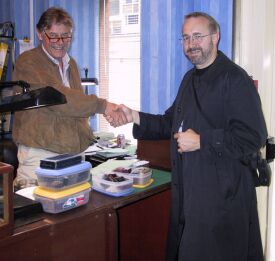
But this was no time to relax! We quickly raced off to the other jeweler and begged him for the on-the-spot appraisal. We held our breath until he declared, "Well, it is a diamond!" He proceeded to explain that it was indeed a miner's cut, and at least 100 years old, by his reckoning.
What?!? He turned back to us. "This is an overblue." ...We looked suitably bewildered. "It fluoresces when exposed to ultraviolet light. If you go to a disco, you'll have a blue halo over your ring," he explained to Vicky Jo. "It'll even glow in bright sunshine." Vicky Jo glowed herself at these words. Examining it again, he claimed it was hand cut from the rough "by someone who knew what they were doing." He nodded his head with enthusiasm. "This stone has character," he declared. "It's not like the stones of today where they use lasers to 'cookie cutter' every bit of diamond they can squeeze out. This was probably cut from a single rock by someone who cared about the stone." His words made Vicky Jo really happy. His words made Robin happy too, because here's the
clincher -- he valued the diamond at nearly 50% more than Robin paid for
it!
So now we had the stone -- the puzzle pieces were falling into place. (Oh! and we found the ring boxes, too.)
|



 As
far as diamonds go, do you know
As
far as diamonds go, do you know 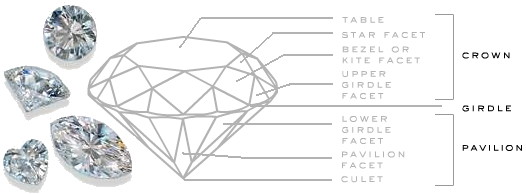

 ; it's also the
hardest of all gems and will endure forever.
; it's also the
hardest of all gems and will endure forever.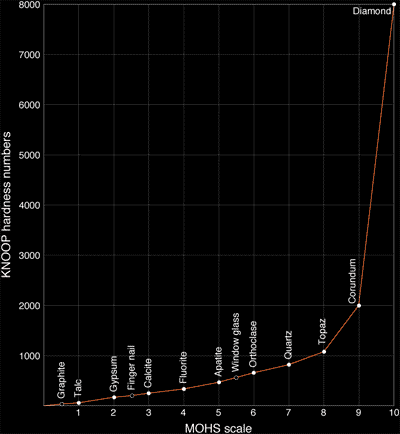

 The other camp
 His viewpoint didn't faze Vicky Jo,
and she had to bite her tongue not to tell John that old style diamonds were being recycled in Beverly Hills to the tune of forty grand! Robin
simply insisted that an old-cut stone was what we were seeking. So John investigated finding a miner's cut
diamond for us, but his attempts were
fruitless, and we were again left to our own devices.
His viewpoint didn't faze Vicky Jo,
and she had to bite her tongue not to tell John that old style diamonds were being recycled in Beverly Hills to the tune of forty grand! Robin
simply insisted that an old-cut stone was what we were seeking. So John investigated finding a miner's cut
diamond for us, but his attempts were
fruitless, and we were again left to our own devices. He
asked the owner for specifics about where the ring boxes came from. They
told him they came from "
He
asked the owner for specifics about where the ring boxes came from. They
told him they came from "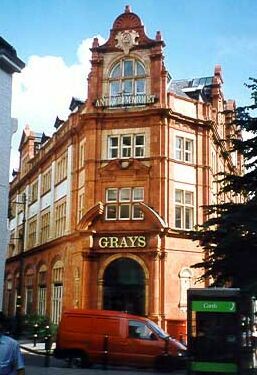
 He
relished telling us how
He
relished telling us how  )
Of course, this nugget of information was intended to drive the price
higher. (We didn't tell him about the Beverly Hills ring either.)
)
Of course, this nugget of information was intended to drive the price
higher. (We didn't tell him about the Beverly Hills ring either.) )
)
 Then he said, "Wait, I think this is -- hmm, let me see." He
reached behind him and switched on a little lamp. Holding the stone
under the light, he exulted, "Yes, it is! This is one of my favorite
types of stone."
Then he said, "Wait, I think this is -- hmm, let me see." He
reached behind him and switched on a little lamp. Holding the stone
under the light, he exulted, "Yes, it is! This is one of my favorite
types of stone."

)